Product

Knowledge GraphEvery record in your plant, connected Morning BriefThe cited daily digest that finds you Platform TiersOne system, floor to leadership Risks, Capacity & ScenariosThe plan, the people, the what-ifs AI Capture & AskSpeak it; structure it; ask it anything

Company

Licensing Security & privacy About Request a walkthrough Log in →

Operations, finally in order.

Your ERP knows what was ordered. Your MES knows what the machines did. Nothing knows how your plant actually ran today. Polyforge is the AI-native system of record that gives leadership one living, connected view of the whole operation — floor to VP. The daily work feeds it: handovers, meetings, and plans captured as structured data, every record confirmed by a person. Built for biotech and pharma manufacturing.

Live product, not a deck · No validation burden · Onboarding design partners now

Shift handover · Night → Day AI draft · pending review
Safety

Wet floor near Buffer Prep — barriered, facilities notified. No injuries.

Production

Batch 24-118 transferred to Bioreactor 3 at 02:40. On schedule.

Equipment

Chromatography skid B pressure trending high — flagged for day-shift check.

Action

Work item PEC-141 created · assigned to Day Shift Lead.

The knowledge graph

Every record in your plant, connected.

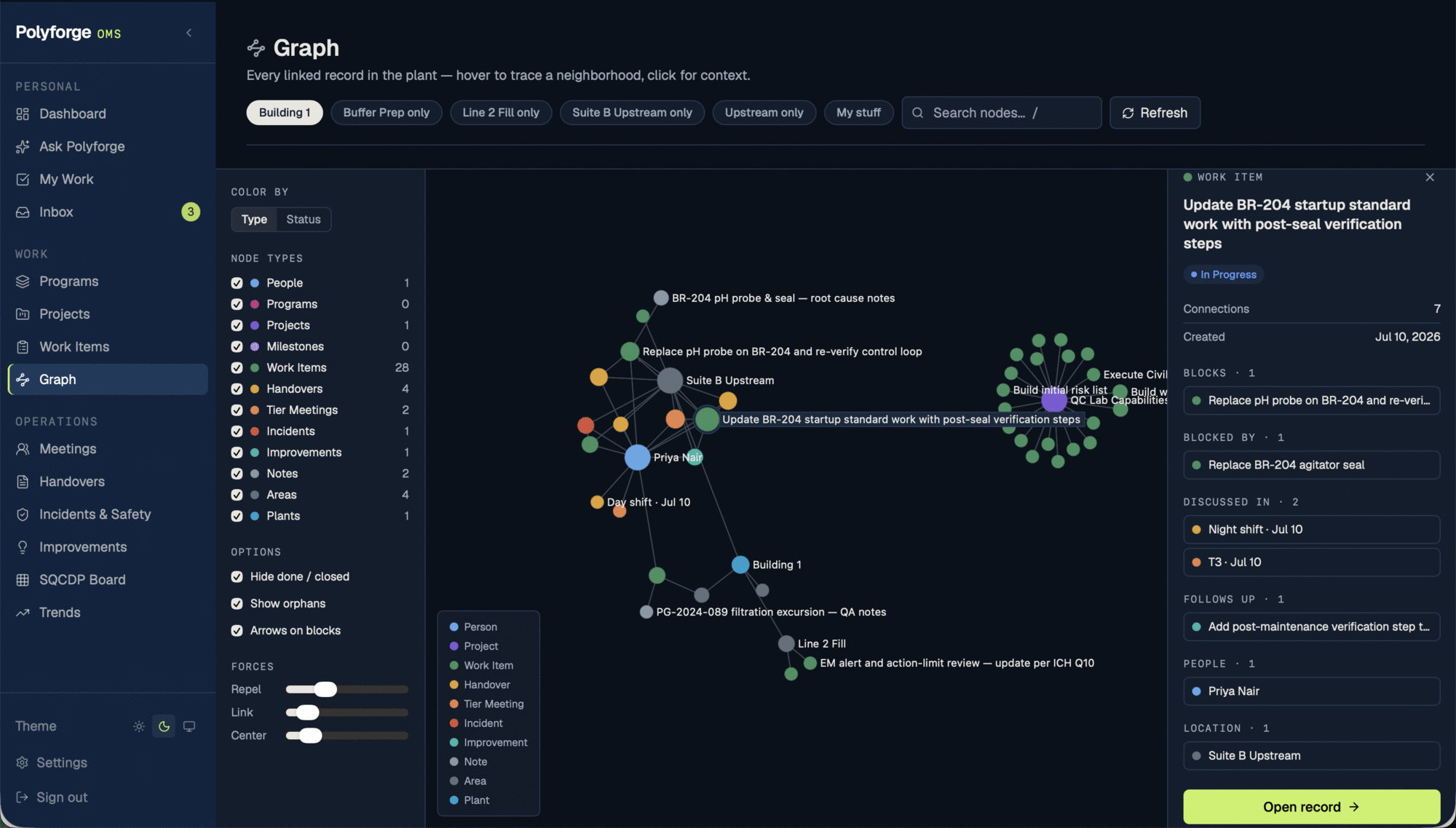
A plant on Polyforge quietly builds something no binder, spreadsheet, or point tool ever produces: a web. The work item knows the handover that first flagged it, the meeting that assigned it, the incident it answers, the project it serves, and the person who owns it, because all of it was captured as one linked record.

The graph draws that web. Hover any record and its world lights up. Click and pivot from handover to work item to meeting to follow-up, the way your plant actually lived it. A second brain for the operation's day: the full context behind any piece of work, one click away.

We've watched a lot of manufacturing software, and none of it can draw this picture, because none of it captures the connections in the first place. Once your daily management is recorded as one connected system, the graph is simply what it looks like.

The plant, connectedLive in product

Every line is a real relationship between real records. Go ahead, drag one.

The Polyforge knowledge graph: a work item at the center connected to its area, owner, blocking items, the handover that flagged it, and the tier meeting that assigned it, with a context panel on the right.
The real product · live today

This is what that spoken handover becomes: one linked record in a web of them. The work item, its owner, the meeting that assigned it, the incident it answers. Everything on this page runs in the same build our design partners use.

New · shipped July 2026

The state of your plant finds you.

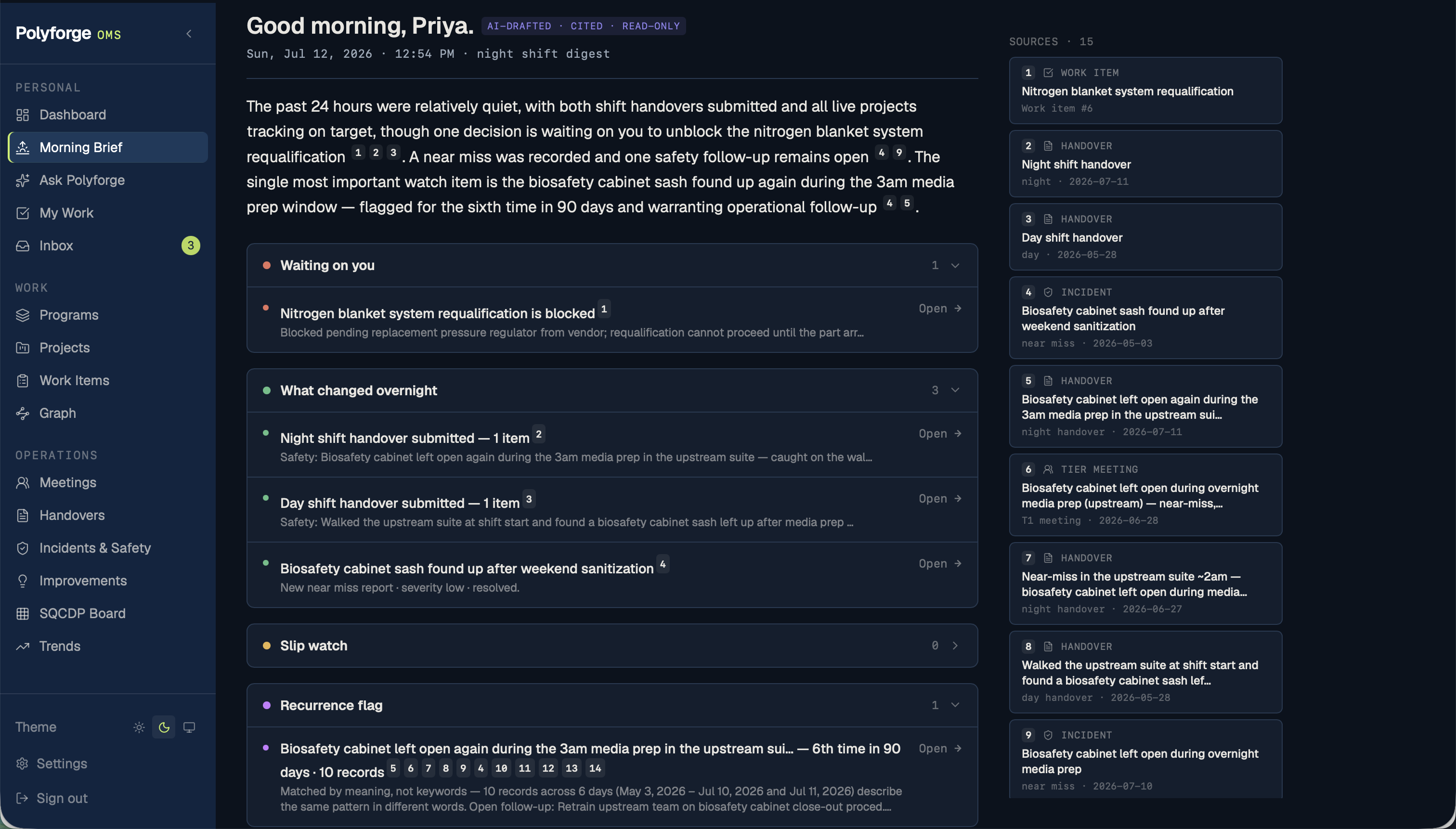
For site directors and VPs: a two-minute brief at the start of every day. What changed overnight, what's slipping, what's waiting on your decision, and what's happening again, every claim cited to the records your team already captured. This morning's plant, with receipts.

The Polyforge Morning Brief: a daily digest opening with decisions waiting on the reader, then overnight changes, schedule slip watch, a recurrence flag showing a pattern matched across six days of records, and a safety pulse — every claim carrying a numbered citation to a source record listed in a rail on the right.
Morning Brief · live today

The part no dashboard does: recurrence, caught by meaning. Ten records across six days, logged by three different people in different words, surface as one pattern ("6th time in 90 days") with every source one click away. Decisions first, news second, and nobody on your team typed a word of it.

The gap

Six systems run your plant. None of them run its day.

ERP

Owns transactions. Orders, inventory, money. (SAP, Oracle.)

MES

Owns machine data. Recipes, equipment, batches in execution.

QMS

Owns the quality record. Deviations, CAPAs, change control, scrap dispositions.

LIMS

Owns lab data. Sample results and specs that release or hold a lot.

CMMS

Owns maintenance. Work orders, parts, preventive schedules.

EHS

Owns regulated compliance. Incidents that must be reported.

The actual day — who's doing what, what broke, what the last shift saw, what the tier meeting decided — lives in Excel, whiteboards, and someone's memory. That's the layer Polyforge owns.

62%

of drug shortages trace to quality and manufacturing failure, not science or demand. The biggest reason drugs don't get made is operational.

FDA · Drug Shortages: Root Causes and Potential Solutions

$0.5–3M

of drug substance at risk in a single complex biologic batch, before counting the investigation, revalidation, and lost finished product that follow a failure.

BioProcess International · industry ranges

~1.5 yrs

the average drug shortage lasts once it starts. Some critical drugs have been in shortage for over a decade. Prevention is the only cheap option.

ASHP / HHS ASPE

We're not promising a dashboard prevents a $3M batch loss. We're saying the failures behind that number start as unclosed actions, missed handoffs, and forgotten precedents: the exact events Polyforge captures, structures, and refuses to let disappear. And while it's closing that gap, it hands your team their day back:

The shift handover

Spoken in two minutes at the end of a twelve-hour shift, then structured into six sections a person reviews before submitting.

"Has this happened before?"

Answered in seconds with citations to your own records, instead of an afternoon of spreadsheet archaeology, or a shrug.

The project plan

Drafted from a short brief into phases, gates, and owned work items, then reviewed and confirmed by the person accountable for it.

The schedule status

Read straight from the live plan. Every project carries a projected finish, and slip gets flagged before it's a surprise.

The platform

One system, four tiers, floor to leadership.

Most software serves one audience and orphans the rest. Polyforge is built on the tiered management structure your plant already runs, so information moves up and decisions move down without re-typing anything. Each tier gives up a chore; every tier above it gets the information without asking for it.

T1 · FRONTLINE

Operators and technicians

Tasks, handovers, and observations captured where the work happens, fast enough that people actually do it.

Time backThe end-of-shift write-up. Speak the handover in two minutes; the record writes itself.

T2 · SUPERVISION

Shift leads and supervisors

Tier boards, escalations, and shift-to-shift continuity. The morning meeting starts from live data instead of a hallway summary.

Time backAssembling the morning meeting. The board is already current when you walk in.

T3 · PLANT MANAGEMENT

Area and plant managers

Cross-area visibility, programs and projects with real projected finishes, and recurring-problem tracking, without chasing fifteen spreadsheets.

Time backChasing status. Projected finishes come from the live plan instead of a Friday email round-up.

T4 · LEADERSHIP

Site directors and VP Operations

What changed, what's stuck, and where the risk is across every plant, in one view, with the full audit trail underneath. The state of the operation as of this morning, not a summary assembled the night before the review, with the exceptions flagged to you instead of buried in someone's inbox.

Time backWaiting for the deck. The risk finds you the day it appears, not in next week's report.

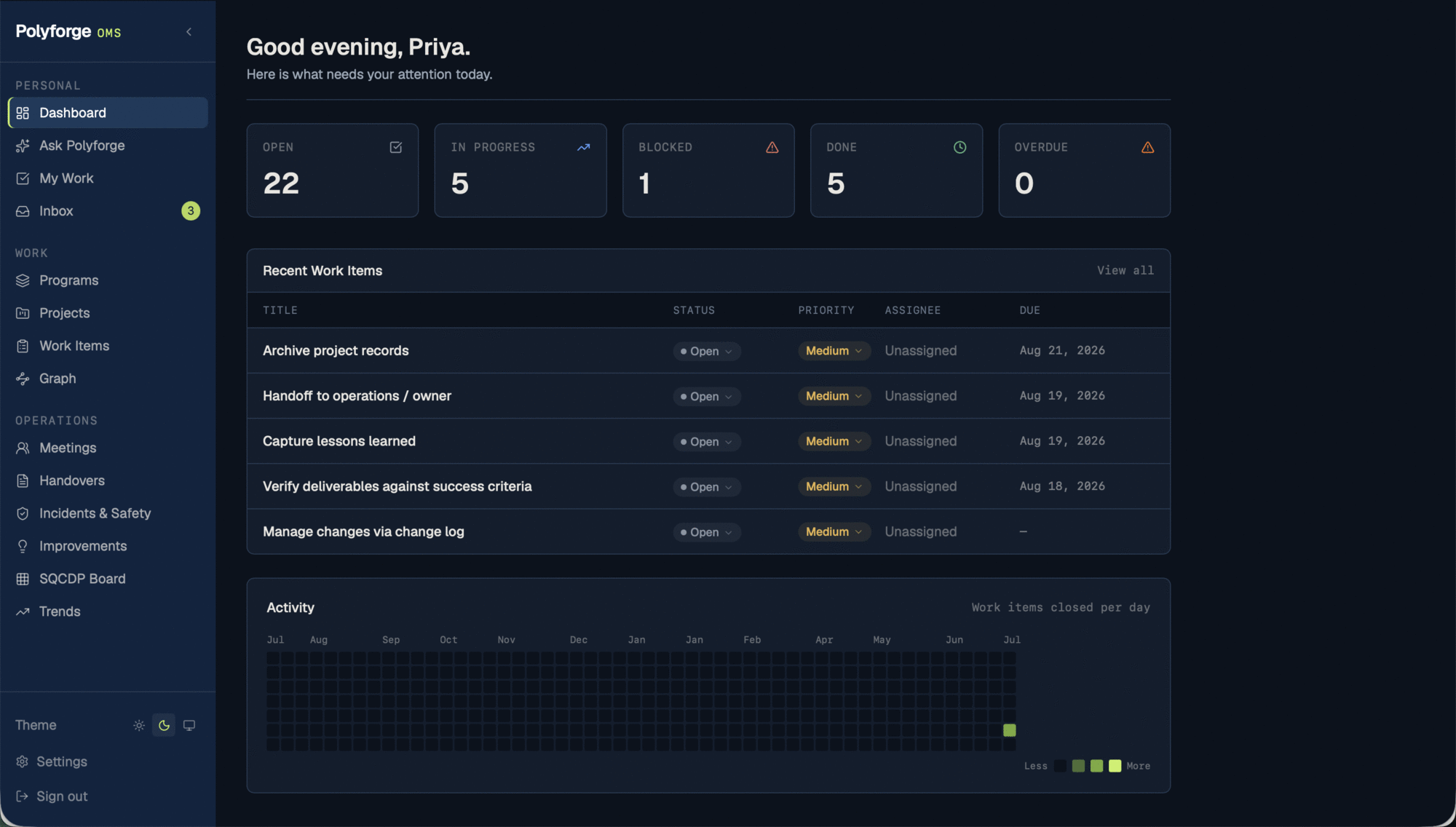
Nobody writes a status update. The status exists anyway.
A personal dashboard in Polyforge with open, in-progress, blocked, done, and overdue counts, a recent work items list with status and assignee, and a daily activity heatmap.
Every tier, one view

From the floor to the VP: what needs attention today, what's blocked, what shipped, without a status meeting to find out.

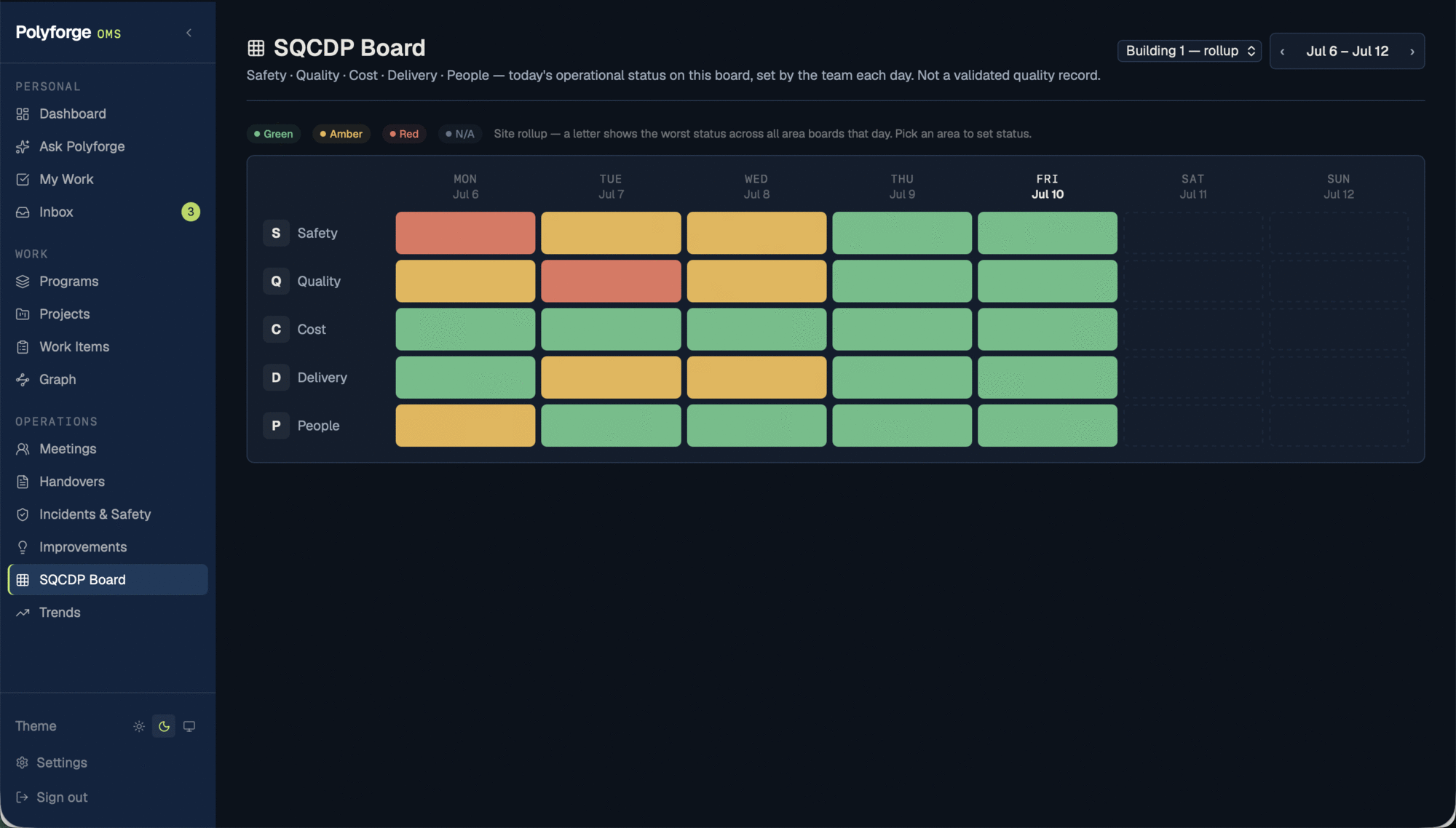
The SQCDP daily-management board in Polyforge showing Safety, Quality, Cost, Delivery, and People status across a week, with issues surfacing early in the week and recovering to green by Friday.
The board your teams already run, now with its history

The pharma-standard SQCDP board every plant works at shift start. Polyforge keeps the streak behind every cell: the trend, the incidents, the actions that turned a red day green.

Shift Handover Tier Meetings Work Items · Projects · Programs AI Capture Ask Polyforge AI Project Drafting Notes & Linking Incidents & Safety CI / Kaizen SQCDP Daily Board Trends & Pareto Knowledge Graph Morning Brief Risk Register Capacity Views Scenario Planning Production Scheduling Reports

Solid = live in the product today · Dashed = on the roadmap

New · shipped July 2026

The plan, the people, the risks: one system doing the math.

Projected finishes were only half the picture. The other half is what threatens them: the risk nobody wrote down, the engineer carrying three projects, the what-if everyone argues about from memory. All three now live in the same plan, computed from the same records. The panels below recreate live product screens, numbers included.

Risk register · Live

The risk, written down where it can act.

Every project and program carries a scored register: probability × impact, an owner, a review date, and mitigations that are real work items in the same plan, not a bullet in a slide. When a review date slides past, it turns red. When a high score has no mitigation behind it, nothing hides that.

And because it's structured, you can interrogate it: "which risks score twelve or higher with no mitigation?" is answered from the register itself, cited. This is the daily coordination layer (the stretched-thin team, the vendor cert that lapses next month) and it sits alongside your QMS's formal risk processes, never inside them.

Risk register · BR-204 reliability
Seal-slip pattern recurs across shiftsP4 × I4162 mitigations
Engineering is single-threaded on one personP4 × I416no mitigation
QC coverage gap on night shiftsP3 × I412no mitigation
Nitrogen vendor certification lapseP3 × I39review 12d overdue

score = probability × impact · every mitigation is a work item with an owner and a status

Capacity · Live

Who's buried this week, and where the number comes from.

The math is simple and visible: hours assigned in the plan, divided by each person's real availability for the week, with time off, ramp-up, and shift pattern already subtracted. Work shared by two people counts half to each, shown as the split, so collaboration doesn't manufacture phantom overload.

The same number appears at every altitude (the person, the team, the scenario sandbox) so the meeting stops being an argument about whose spreadsheet is right.

Capacity · this week
Priya N.Engineering46h / 40h · 115% — buried
Sarah O.QC · OOO Wed–Fri22h / 16.8h · 131% — no coverage

over only because of the absence — the work needs a new owner, not overtime

Tomás I.Ramping · week 2 of 614h / 24h · 58%
James W.Facilities18h / 36h · 50% — slack

assigned ÷ available · shared items rendered as the split (16h ÷ 2) · the tick is 100%

Scenario planning · Live

Your most-loaded person isn't your bottleneck.

The what-if that used to cost a spreadsheet and a weekend: perturb the plan in a sandbox (lose two operators, add contractors, relieve your busiest engineer) and the projected finish moves, computed by the same engine that runs your timelines.

It finds the counterintuitive answer honestly: relieving the person at 115% often recovers nothing, because the schedule was hanging on a different item entirely. Polyforge recommends; a person selects. The sandbox writes nothing to your plan.

Scenario · verification step slipping
Relieve your busiest person — 115%, but off the critical path+0 days
Reinforce the one item the schedule hangs on6 days backRecommended
Accept the slip+0 days

recommendations never push anyone past 100% · selecting reveals draft moves — applying would create ordinary, logged edits a person confirms

AI, in the right place

AI that removes the busywork, not the accountability.

Plant-floor software dies from data-entry friction. Polyforge puts AI to work across the whole day, capturing, recalling, reasoning, and increasingly acting, while a person owns every decision and every record. Each rung is only possible because the one below it captured clean, structured data.

01 · CAPTURE — LIVE

Speak it. Polyforge structures it.

A supervisor talks through the shift; the handover writes itself into structured sections. You watched it happen at the top of this page. Tier meetings capture the same way, and a person confirms every word before anything is saved.

02 · RECALL — LIVE

Ask your plant anything.

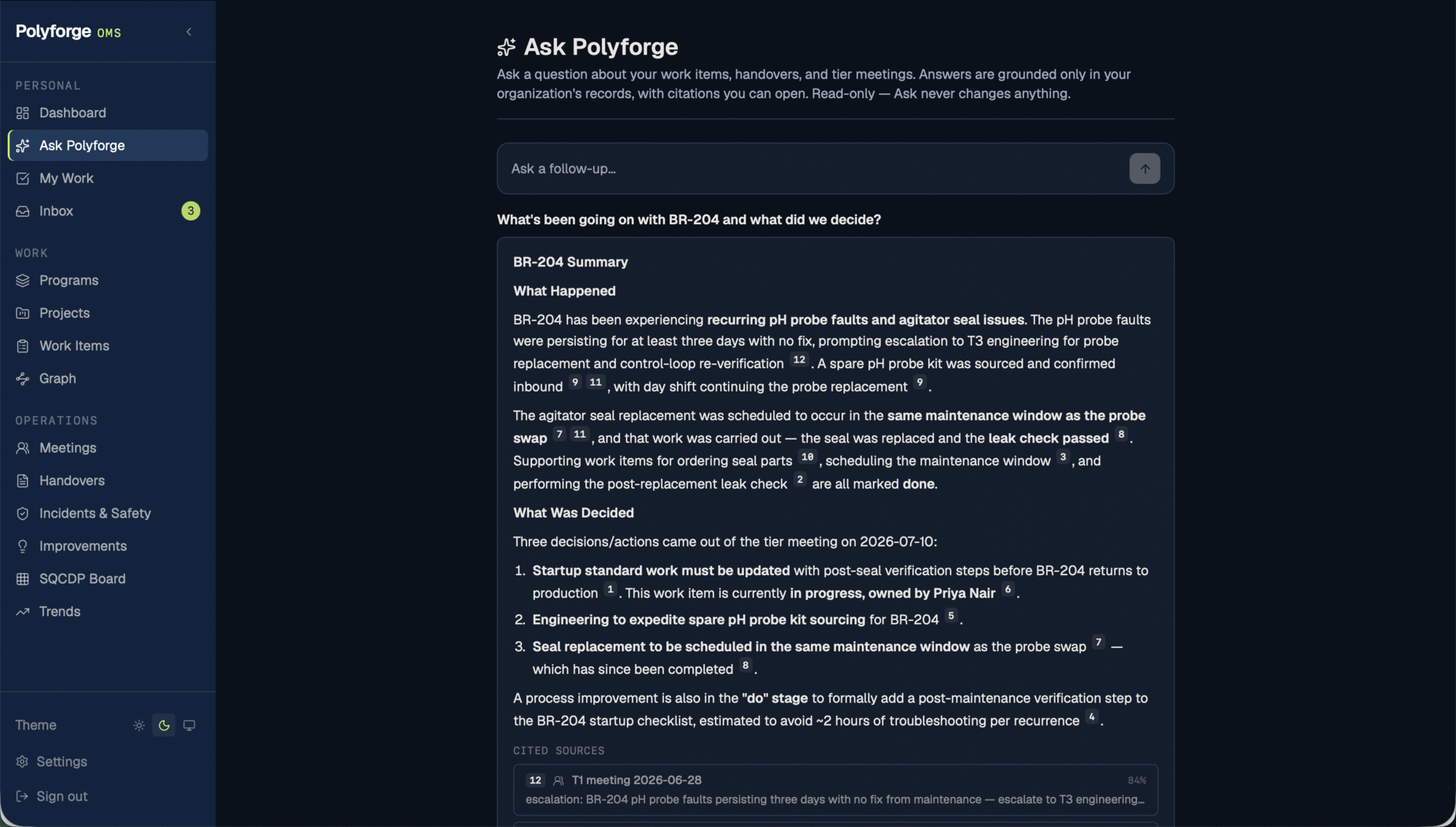
Search your plant's history by meaning, not keywords. The same problem described differently three months ago surfaces in seconds. Ask a question in plain English and get a plain-English answer, every claim cited back to your own records.

Ask Polyforge answering a plain-English question about BR-204 with a synthesized summary and numbered citations to the underlying handover, tier meeting, and work items.
Answers with receipts

An answer assembled from handovers, meetings, and work items, every claim cited to the record it came from.

03 · REASON — FIRST PIECES LIVE

The slip, before it's a surprise.

"Which projects are behind schedule?" is answered from the live plan: every project carries a projected finish derived from the actual work and its dependencies. The Morning Brief's recurrence flag matches the same problem across records by meaning, and the scenario sandbox reruns the whole schedule against a what-if. Deeper cross-module reasoning is in build.

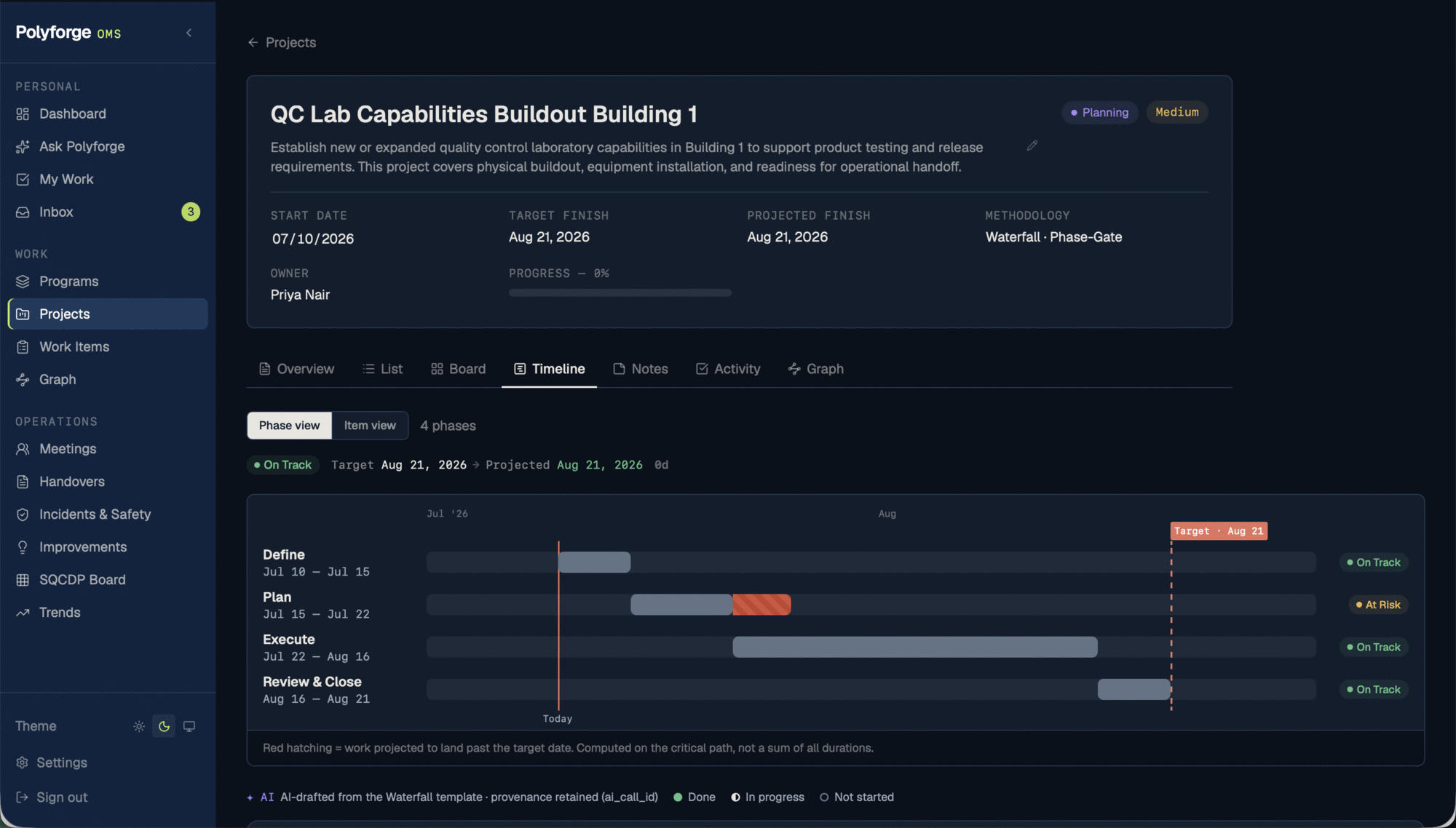
A project timeline in Polyforge with a phase-gate Gantt view, where a phase projected to land past its target date is flagged At Risk with red hatching on the critical path.
Computed from the plan, not the status meeting

Phase-gate timelines compute projected finish on the critical path and flag it before the target date arrives.

04 · ACT — THE DIRECTION

The busywork, handled.

Agents assemble the tier board before the meeting, chase overdue actions up the escalation ladder, and draft the incident write-up, so your team spends its time deciding instead of assembling. The first half of this rung already exists: the scenario sandbox drafts response options and recommends one, while a person selects and confirms. The direction is agents that do the assembling and chasing themselves: always drafting, never deciding.

In the product today

AI handover capture AI meeting capture Ask Polyforge — cited answers AI project drafting Schedule feasibility & slip flags Semantic search Structured notes & cross-linking Knowledge graph — the connected plant Morning Brief — the cited daily digest Risk register — scored, linked to the plan Capacity — who's buried this week Scenario planning — sandboxed what-ifs
The line we don't cross

AI drafts, routes, and chases. Humans confirm and decide. No model writes directly to your records, computes a compliance state, or touches the audit trail, even as it takes on more of the busywork. Every AI-drafted entry is flagged as such, permanently. In your industry, that's the requirement.

Where this goes

First your operations become recorded. Then searchable. Then queryable. Then the busywork starts running itself.

Every handover, meeting, plan, and decision becomes structured, attributed data the moment it happens, instead of a memory to reconstruct later. That corpus is what changes how a plant runs: the tier meeting starts from a board that built itself, the overdue action gets chased without a supervisor babysitting a spreadsheet, the weekly ops report arrives drafted, and the recurring failure gets named the third time it happens, not the tenth.

That's the operating layer we're building toward, one rung at a time, and we'll always say plainly which rung is live, which is in build, and which is still direction. What never changes: a human owns every record and every consequential call.

Security & privacy

GxP-adjacent, by design.

Polyforge runs the daily management layer: the work that happens outside your validated systems, feeding cleaner signal to the ones inside. No 21 CFR Part 11 scope, no validation project, no six-month IT review before your first tier meeting runs on it.

  • Biotech and pharmaceutical manufacturing plants
  • CDMOs and contract manufacturers
  • Single sites today, multi-plant networks tomorrow
Engineering posture
audit_log   append-only, database-enforced
tenancy     row-level isolation per organization
history     every change attributed, timestamped
deletes     archival only — records never vanish
ai_writes   human-confirmed, provenance-flagged
ai_answers cited to source records, checkable
ai_model    Anthropic Claude, commercial API terms
ai_training none — your data trains no model
encryption AES-256 at rest · TLS in transit
infra       SOC 2 Type II audited providers

Your data is yours.

Everything your team captures belongs to your organization. Polyforge is the custodian, never the owner. It lives encrypted (AES-256 at rest, TLS in transit) on SOC 2 Type II audited infrastructure, isolated per organization at the database row level. If you leave, your data leaves with you. We will never sell it, share it, or mine it for anyone else's benefit.

It trains nothing.

The AI is Anthropic's Claude, accessed under commercial API terms that prohibit training on customer data. Your records are never used to train a model: not ours, not Anthropic's. The AI reads them to draft and answer, then forgets; the learning stays with your team, where it belongs.

Nothing is saved behind your back.

When AI processes a handover or meeting, the screen says so, and nothing persists until a person reviews and hits Submit. What isn't confirmed isn't stored. This site follows the same manners: no trackers, no ad pixels. The only data we collect here is what you type into the form.

Design partner program

We're taking five plants with us.

Polyforge is being built shoulder-to-shoulder with a small group of design partners. Partners pay a nominal fee (skin in the game on both sides) and shape the product around how their plant actually works.

What you get

  • The platform, live in your plant within days
  • A weekly 30-minute call with the founder; your feedback ships, often the same week
  • Founding-partner pricing, locked permanently
  • Direct influence over the roadmap while it's still wet cement

What we ask

  • Real daily use by at least one team or area
  • Honest feedback, especially when something's wrong
  • A reference conversation if we've earned it
Request a walkthrough
About

Built from inside the industry.

I'm Jared Broberg. I've spent fifteen years in biotech manufacturing operations — leading GMP clinical manufacturing at Sartorius, and before that a decade at Thermo Fisher across fill/finish and viral-vector production — inside the plants this software is for: sitting in the tier meetings, reading the handover binders, watching critical knowledge live and die in spreadsheets named FINAL_v7_USE_THIS_ONE.xlsx.

Polyforge exists because the tools offered to plant teams were built by people who'd never stood in one. Every feature here started as a real problem I watched a real team work around. I use the product every day, and design partners talk directly to the person writing the code.

No sales team. No implementation consultants. Just software that knows how a plant runs.

Get in touch

See it against your own plant's day.

Tell us a little about your operation and we'll set up a 30-minute walkthrough: the live product and your questions.

Prefer email? Write to hello@polyforgehq.com. It goes straight to the founder.

No newsletter, no drip campaign. You'll hear back from a person.

Received

Thanks, your note is in. Jared will follow up with you personally.